Heat pumps explained: benefits, costs and installation for UK businesses
Read time: 3 minutes

Read time: 3 minutes
With rising energy costs, carbon targets and increasing pressure from customers, investors and regulators, more organisations are exploring low-carbon heating solutions. Heat pumps are one of the most mature and efficient technologies available, helping businesses reduce carbon emissions, improve energy efficiency and futureproof their operations.
This guide explains how commercial heat pumps work, their benefits, costs, suitability and the key considerations before installation, drawing on insights from industry experts and Green Economy's consultants.
Heating remains one of the UK's largest sources of carbon emissions. Presently, domestic heating accounts for roughly 14 per cent of UK emissions, while all heating accounts for approximately 37 per cent of national carbon emissions.
The government is doing things to support, incentivise, and encourage decarbonisation of heat, such as requiring the energy performance certificate of a building to be publicly displayed, but the challenge of decarbonising UK heat carries an estimated cost of £200bn.
The UK government has set ambitious targets to reduce business energy use with a target to install 600,000 heat pumps a year by 2028. If this target isn't met it could see the UK pay an extra £9bn for gas imports.
Reducing emissions from heat can help businesses:


A heat pump is a heating and cooling system that transfers heat from one location to another using electricity.
Rather than generating heat through combustion, heat pumps capture and move existing heat from the air, ground or water. This makes them significantly more efficient than many traditional heating systems.
The technology is not new, it is based on the same refrigeration cycle used in refrigerators and air conditioning systems, a principle that has existed since the 19th century.
Heat pumps use a refrigeration cycle to absorb heat from the surrounding environment and transfer it into a building.
This ability to provide both heating and cooling can make heat pumps an attractive option for many commercial properties.
One of the biggest misconceptions is that heat pumps only work in new buildings.
Building efficiency is generally more important than the age or size of the property. Well-insulated and energy-efficient buildings often achieve the best results.
Before installation, consider:
Many organisations benefit from carrying out an energy assessment before engaging suppliers.
Businesses need to identify where system components will be located and whether suitable space is available.
Heat pumps generally deliver the greatest benefits when paired with broader energy efficiency improvements.
Understanding how much energy a building consumes and when demand occurs can help inform system design and maximise performance.
Obtaining a clear site survey and detailed specification before approaching suppliers can help businesses compare proposals more effectively.
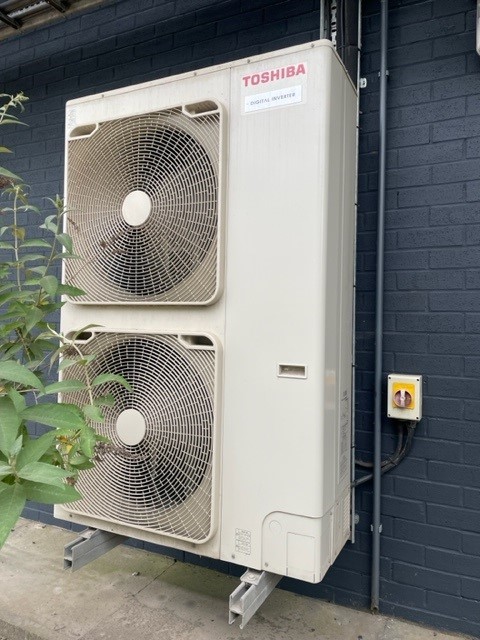
Jamie Hull, Managing Director at Un.Titled Studios spoke about installing a heat pump:
"We reduced our energy consumption and, as a result, generated savings in our energy bills and carbon emissions. We saw a return on investment within six months.”
There can be restrictions in locating an air source heat pump outside of your building, as they require suitable space.
One consistent restriction is the logistics of getting the pipework into the building to ensure the heat pump is working effectively. Any alterations you may need to make in this building to ensure you are maximising the efficiency of your heat pump need to be acknowledged. That’s down to the consultant and the installer to set realistic expectations for the client.
Ensure the building owner is on board. Sometimes, if the building is under lease the decision making in terms of heating and hot water systems may not lie with the business.
An air source heat pump extracts heat from the outside air, while a ground source heat pump draws heat from the ground through buried pipes. Both technologies can reduce carbon emissions, but the most suitable option depends on site conditions, available space and heating requirements.
Businesses should ensure quotations clearly explain the proposed system, expected performance and installation requirements.
We provide free, impartial advice when procuring heating technologies, connecting you with local experts.
Potential savings depend on factors such as building efficiency, energy costs, system design and how the heat pump is operated. Businesses should conduct an energy assessment to understand the likely financial benefits for their specific circumstances.
Space requirements vary depending on the size and type of system. Businesses should consider where external and internal equipment can be located and whether the available space allows the system to operate effectively. Explore our Marketplace to find a local supplier to help you assess this for your buildings.
Green Economy can help organisations understand their options, connect with trusted suppliers and develop practical plans to reduce energy use and carbon emissions. We work with businesses looking to invest in low-carbon and energy-efficient technologies - get in touch to find out more.
Before investing in a heat pump, businesses should assess:
Industry experts also recommend carrying out an independent survey before engaging installers.
Yes. Heat pumps work by extracting heat from the outside air or ground, even when temperatures are low and can continue providing reliable heating throughout winter.
While efficiency reduces as outdoor temperatures fall, today's systems are far more effective in cold weather than earlier generations.
A well-designed and properly maintained commercial heat pump will typically last 15 to 20 years, although some systems can operate for longer. Lifespan depends on factors such as installation quality, operating conditions, system sizing and maintenance. Regular servicing and filter changes can significantly extend the life of the equipment
Modern heat pumps are generally quiet - some outdoor units produce a low level of operational noise, similar to an air conditioning unit.
Noise levels vary by manufacturer and model, but in most commercial settings they are unlikely to cause disruption when correctly specified and installed. Site location and acoustic considerations should form part of the design process.
Discuss this with your installer during planning to understand this risk and identify models which will best suit your business need.
Heat pumps require relatively little routine maintenance compared with combustion-based heating systems. Recommended maintenance may include:
Regular maintenance will help to maintain the efficiency of the heat pump, preventing breakdowns and maximising system lifespan.
Funding schemes and eligibility criteria change regularly. Green Economy can help businesses identify suitable funding opportunities and connect with trusted suppliers to assess the feasibility of heat pump projects.
This one hour discussion brings together installers, business advisors and technology experts to discuss all you need to know about procuring, installing and maximising value from a heat pump.
During this webinar our panel of experts looked at the potential that this technology can afford a business looking to minimize energy costs and reduce reliance on gas supplies. The panel offer insights into the installation process, including time frames and how this might impact the day-to-day running of your business, as well as the potential return on investment and the financial routes that you can consider when purchasing.
Panellists included Charlotte Lee, Chief Executive, Heat Pump Association and Andy Louth, Managing Director, Groundtherm.

We are a social enterprise building a more sustainable economy, powered by local suppliers. We help organisations leverage sustainability to grow, while helping green tech and environmental services business win new business in their local area.
If you're interested in exploring how we can help your business grow, get in touch and one of our expert advisors will be happy to help.
Share
Written by
